Showing posts with label Free Things To Do In Rome. Show all posts

Thursday, February 7, 2013

Happy Chinese New Year

Buon nuovo anno cinese! Happy Chinese New Year!
Though the date is officially on Sun. Feb. 10th this year, Rome decided to celebrate the year of the snake just under a week before it truly begins. As an officially recognized sister-city to Beijing, Roman citizens happily accepted the four groups of entertainers from China last Saturday, February 2, a chilly and rain-threatening night. Luckily, it never rained, and the best part about the event was that it's one of the many Free Things To Do In Rome, if you time it right.
Among the participants were the famous Chinese Three Tenors, two of whom were actually on key and in tempo enough to actually earn my respect. The others groups were large dance ensembles which had impressive choreography, lending itself to be something of a a carnival side show with awe-inducing, crowd-pleasing acrobatics.
The evening began with a short parade down the main street all visitors of Rome remember.  You know, that long road that leads from the big white temple looking thing (Vittorio Emmanuele Monument) to the Coliseum. Four white, furry and enormous Chinese dogs led the way to the stage. Each dog had the face of a dragon-pug, the coat of a woolly mammoth, and the extending abdominal capability previously used  by Inspector Gadget.
As two very strong and flexible men wore the dog costume, one lifted the other high in the air doubling the size of the dog.  The happy puppies jumped for joy.  The New Year was almost here.
The beating drums followed the dogs and behind them, two dragons danced through the air, one of red, the other yellow. The members of the dance teams guided the fire-breathing beasts above their heads all the way to the stage.  And once Rome's municipal police band finished their set, the show was on.

The Chinese New Year in Rome was a magical time and well worth bundling on the layers to stay warm.  The shows were stunning.  The costumes and music were mystifying. I was transported to alternate universes only James Cameron could dream of.

Happy Chinese New Year everyone.

Thursday, April 26, 2012

The Best Illusion In Rome


Remember the haunted mansion at Disney’s theme parks? In the late 80’s, I thought it was one of the greatest things while sitting in their high-backed chairs rotating every which way to delightfully frighten me passed floating candles, roaming ghosts and talking paintings. My favorite part was the illusion where the chairs arranged themselves side by side, the back of that chair in front of you no longer visible. You notice a set of 3 or 5 mirrors fixed on the wall as you steadily approach them.  Once there, you look directly in the mirror to see yourself and sitting right next to you is your new friend with his evil grin, a ghastly translucent ghoul.

In Rome, illusions like that are harder to come by.  There’s a newly opened theme park called Magicland.  Indeed, it sounds magical but unfortunately I have not made it out there to review it. Haunted houses didn’t seem to be easily found during Halloween the way they are rather abundant in the United States, so that option is out too.  What are you left with?

The miracle of natural illusions.

Nothing is more fascinating than a natural illusion.  It’s stupefying. It’s thought-inducing. It’s hard to imagine that something so real is actually real!

And I have found it for you.  Best of all, it’s one of Rome’s Free Things To Do and it answers this age-old riddle!

What gets larger as you walk away from it, and gets smaller as you walk closer to it?

When in Rome, go to the Aventine Hill to find it.  Right in between Circo Massimo (Circus Maximus) and the Tiber River, this ancient hill is populated with churches, residences, business offices and embassies. It’s a gorgeous area just to walk through for picture reasons. There’s a fantastic location I might post about which allows you to see through three different countries at the same time without special ocular equipment. And then there is the Best Illusion in Rome.

Connected to the church of S. Sabina (Santa Sabina) is a plot of land transformed into the most romantic of parks.  Orange trees dot the majority of the green space, their lines quite clear where orange pickers couldn’t reach any higher. A large white-pebble walkway covers the majority of the area with benches placed strategically for people-watching. The skyscraping umbrella pines shade most of the area, an occasional ray of sunlight bursts through making the pebble blindingly white. 

And then you get to the platform where you look over the wall’s edge.  You are high above the Tiber River. This is a unique view of the city. Directly in your vision is St. Peter’s Basilica.  It is far away, very far.  The mass of buildings and trees in between you and the famous Vatican City location make it appear tiny.  And that’s expected considering how far you are from it.

Then you leave.  You walk down the steps, walking straight down that white pebble path to the wall separating the park and the street. Before you leave, you turn around to catch one last glimpse and there it is.

St. Peter’s Basilica is the only thing you can see now, and it seems as if it magically doubled in size.
How the brain perceives images is beyond my VASGOness but I know when something is special and when it’s not.  This, my friends, is something worth seeing for yourself. The camera alone does not do it justice.

Visit the park connected to the church called S. Sabina (Santa Sabina) on the Aventine Hill for the best natural illusion Rome has to offer! 

Wednesday, April 11, 2012

Italy's Free Museum Week

If I could rank the many Free Things To Do In Rome, this would likely be the #1 thing to do.

Each year, Italy's Ministry of Heritage and Cultural Activities works with nearly EVERY STATE-RUN MUSEUM in Italy to open its doors to the public and for one week, one wonderful, enlightening, inspiring, delightful treasure of a week, the entrance fees are complimentary.  That's a much lengthier synonym for one of my favorite smaller words, FREE.

It's official name: Settimana Della Cultura
Translation: Week of Culture
VASGO's Translation: Italy's Free Museum Week

Want to go to the Colosseum and see what the gladiators had to fight in?  Yep, that's free.
Want to go to the Roman Forum and see (just a few) pieces of column laying around? Yep, that's also free.
What about the Baths of Caracalla with their outstanding collection of mosaics from ancient times? Again, free.
What about the museum that perfectly combines industrial space with classic art, the Centrale Montemartini? I bet you that's free too!
In 2012, the Settimana Della Cultura starts Saturday, April 14 and ends Sunday, April 22.

This is the 14th year of the nine-day event created to promote and enhance Italian culture and heritage country-wide. It is said that not just museums are offering free admission. Villas, monuments, archaeological sites, archives and state libraries will also be welcoming visitors with open arms. Hugs, however, are said to be more expensive than usual.

Get it?  Open arms... hugs...

Awful.

The website for Italy's Ministry of Heritage and Cultural Activities even states that the experience will be even more special due to the many exhibitions, conferences, special openings, workshops, tours and concerts that will be available.

If you are going to spend your hard-earned money to come to Italy, you may as well save a buck or two on all the admission fees. Come during the Settimana Della Cultura.  Just be ready for the longer entrance queues!

For more information go to the ministry's website, available only in Italian, here: http://www.beniculturali.it
Specific information (again, only in Italian) about Rome's and its nearby cities in the Lazio state's offerings can be found here: At this .pdf

Monday, April 9, 2012

The Pilgrimage

Fearful of floating in nothingness for too long once you die? Anxious about your after-death sentence to heaven or hell? Do yourself and your loved ones a favor - reduce your time spent in Purgatory by going on a pilgrimage to the four Papal Basilicas all in one day like the people of old did (and possibly still do today).

That's how I would advertise pilgrimages if I worked for the Vatican. Luckily for them, I'm not in advertising.  However, I am into writing about fascinating things to do while in Rome, and this historical, religious journey was foreign to me until recently.

My Roman history expert shed light on the subject, about the many journeys from around the world to visit the four Papal Basilicas of Rome, which are:

  • Saint Paul Outside the Walls (San Paolo Fuori le Mura)
  • Saint Mary Major (Santa Maria Maggiore)
  • Saint John Lateran (San Giovanni in Laterano
  • Saint Peter's Basilica (San Pietro in Vaticano)  Easily the most popular one being in the Vatican City, so start or end your day there to avoid this long queue.

For those not participating in a pilgrimage for strictly religious reasons, I think it is worth attempting for a number of reasons.

  1. The Basilicas are huge! We are talking awe-inspiring grandiose structures folks. You  somehow  feel ... different when you stand inside, looking up and around, taking it all in.
  2. See what makes each one different! No Basilica is the same. Each has it's own unique flavor of design, both interior and exterior and are well worth viewing.
  3. Compare their Papal Altars. In each one, a special altar resides for only the Pope to conduct his own Mass. 
  4. Consider each location's relic. These ancient religious objects may be a part of the body of a saint or may have been an object that a saint touched or used at one point in history. Each Basilica's relic has it's own fascinating story.
  5. The artwork and sculptures! There are some extremely popular items in the Basilicas you would not want to miss viewing in person. For example, Michelangelo's The Pieta sculpture is in St. Peter's. Simply amazing work.
  6. It's one of the many Free Things To Do In Rome! Enough said.

I have taken many a photo of the insides of each Basilica and I almost posted them for you. But I abstain. This is something you should see without my influence.  It's sooooo much greater in person.

Here are the Basilicas and their closest metro stops for your convenience.

  • Saint Paul Outside the Wall (San Paolo Fuori le Mura) - Metro B line, stop name: Basilica S. Paolo
  • Saint Mary Major (Santa Maria Maggiore) - Metro A/B line, stop name: Termini
  • Saint John Lateran (San Giovanni in Laterano)  - Metro A line, stop name: San Giovanni
  • Saint Peter's Basilica (San Pietro in Vaticano) - Metro A line, stop name: Ottaviano - S. Pietro
Happy Pilgrimage, whatever the reason!

Thursday, December 15, 2011

The Histories of Panettone and Pandoro


Attending the Panettone and Pandoro Festival was wonderful because in addition to the samples from all the vendors, a section was dedicated to the history of both sweet breads. 

Feeding my mouth was just as important as feeding my mind. So I’ll do the same.  Here!  Have some panettone.  Now you can read on how these breads came to be.

The Legend of Panettone
Translation by my expert.  Grammatical edits by just VASGO.


Surely the most trusted and interesting story to recount concerning the birth of panettone is a story that goes back a long, long time and speaks of a youth of the name Ughetto.

One narrates that Ughetto, son of the ducal falconer Giacometto degli Atellani, had fallen in love with the beautiful Adalgisa, daughter of a modest baker.

Unfortunately, however, the great social divide between Ughetto and Adalgisa made a marriage between the two of them impossible.


In spite of everything, the two enamored youths continued to see each other in secret.

For Adalgisa’s father, the bakery’s affairs were not well and so Ughetto had an idea to resolve all their problems: he disguised himself, offered himself to Adalgisa’s father as an apprentice and began to vary all the ingredients of bread, transforming it into panettone.

The recipe was a great success to the point that the economic situation of the baker improved.


And it was so that finally Ughetto and Adalgisa were able to marry each other.  Meanwhile, panettone increased in popularity so much that it became a Christmas tradition in the whole world.

The Birth of Pandoro


The origins of pandoro are not certain.  There are those who say it goes back to the Hapsburg Empire in Austria. In fact,it would have been the pastry of the royal house of Vienna, prepared as the “ancestor” of pandoro, later becoming the “Bread of Vienna”, a variation of the French dough, brioche.

Others suggest, instead, it is native to the republic of Venice, Italy in the renaissance when the rich patrician families consumed a sweet called “Bread of Gold”, which was entirely covered in thin sheets of pure gold.


The most certain ancestors seem to be, however, those which bring it back to “Nadalin”, a sweet in the form of a star.  According to tradition at the end of the 19th century, families from Verona prepared this for Christmas.

Probably in the conception of the sweet, there entered also the Austrian pastries, which in these times were largely occupied in the more renowned bakeries of the historic center of Verona, Italy. At the end of the 19th century, pandoro had been the most typical expression of the sweets producers of Verona. Today it is consumed in all of Italy and it became, together with panettone, one of the typical sweets of Christmas festivities.

The name pandoro perfectly describes the color, which characterizes its dough, yellow gold, given to it from eggs. The consistency is soft and smooth, like brioche, from which it is probably derived. The flavor is delicate and smoothly perfumed with vanilla. From the “nadalin”, pandoro still keeps today the form of a star. Its unmistakable truncated-cone structure, large ribs arranged according to a typical design of an 8-pointed star, is obtained using a tall mold in the form of a truncated pyramid, divided in sections of acute angles.

Wednesday, December 14, 2011

Panettone and Pandoro Festival

Wonder of wonders!  My expert stumbled on some great news right before December hit!  Panettone and Pandoro Festival was being held in Rome the weekend right after Thanksgiving and I had never tried either dolce.  It was also one of the many FREE THINSG TO DO IN ROME which made it even better!


I’d heard of panettone - a dessert bread filled with raisins and other candied fruits.  Pandoro was still a Roman mystery to me.  


The walk inside a conference center near Piazza di Spagna filled my nostrils with sweet, perfumed air. It was like walking into your favorite bakery at 5am when all their pastries were just taken out of the oven.

Once inside, you are overwhelmed with a table of a single HUGE loaf of panettone!  It was ginormous!  That's even bigger than enormous.
There lots of vendors each offering their own Christmas sweet.
Pandoro is the bread on the right.  It has no fruit in it and the sweet dough is soft, chewy and I got hints of light almond and even orange when eating it!
Samples were offered at nearly every table, making the free aspect of attending the event even sweeter.
If you look at this plastic-wrapped star-shaped loaf of pandoro, you'll notice the mold below it.  An even closer view reveals for 200 EURO, you can have both!  Not sure if that's a good deal or not.  But you can trust me when I say the bread was HUGE!
Many vendors offered more than just classic panettone with candied fruit and raisins in it.  This vendor offered varieties such as chocolate, limoncello, pistacchio and apricot!
This vendor decided to focus more on the bread's sidekick, citrus infused white chocolate.
Indeed, it turned out delicious with pandoro.
And then there were other sweets like this candied fruit bread.
Panettone does not usually have serious cake decorations like above.  You might see it lighlty iced and even more common is nothing on it.  But however you find it, give it a try!  Not a candied fruit or raisin lover?  Take a risk and try it anyway.  I usually dislike those in breads but now I'm convinced it is outstanding!

Stay tuned for the fascinating background on how these breads came about in tomorrow's episode.  Same VASGO time, same VASGO channel!

Friday, December 9, 2011

Chocolate Festival

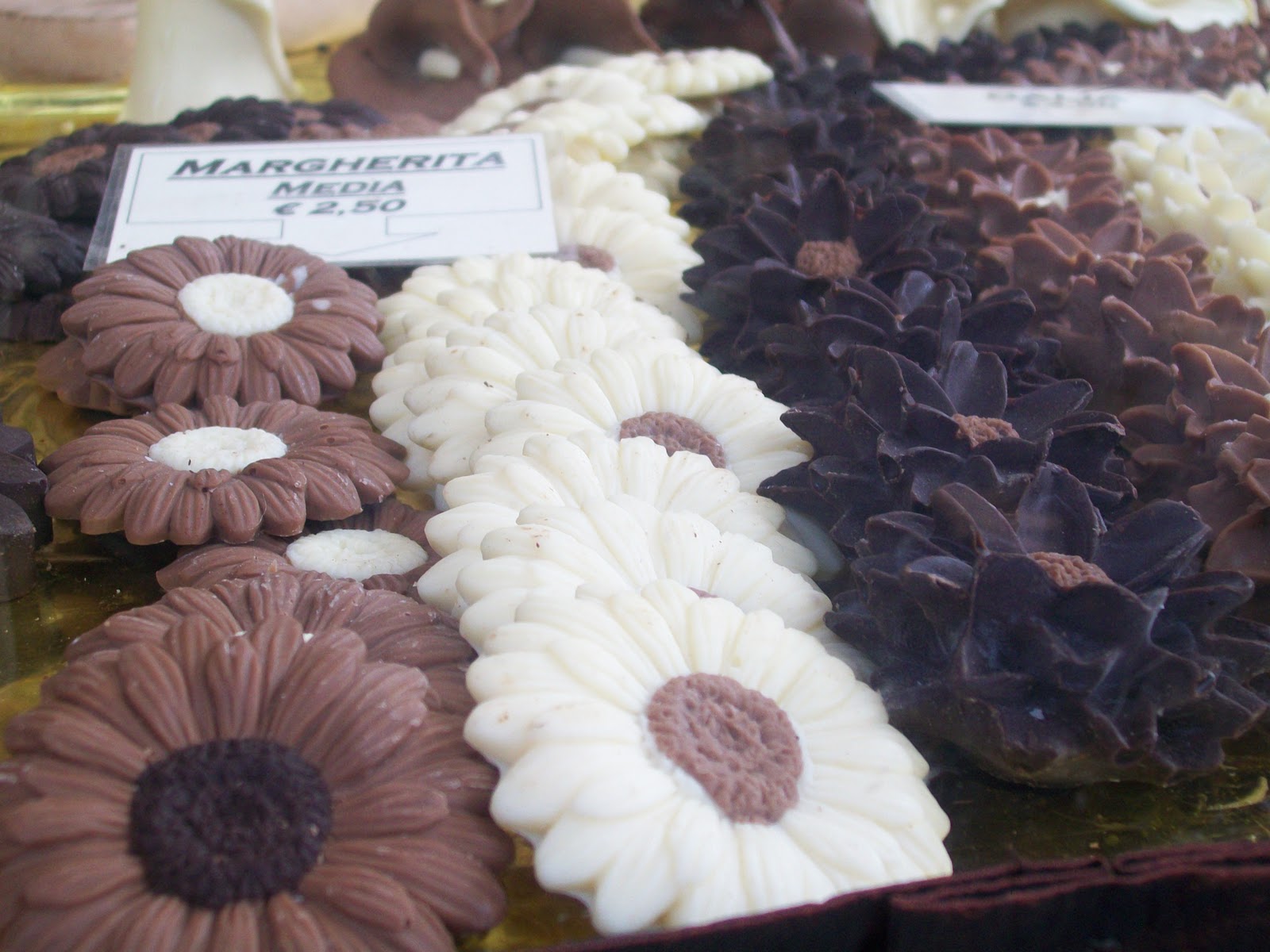
If you were in Rome for the last two weeks, you had the opportunity to attend two different chocolate festivals! These are definitely fantastic to go to when in Rome because it is one of the many FREE THINGS TO DO IN ROME! (if you can hold back from buying something)

My expert and I decided to visit the one in central Rome, located in a popular and touristy neighborhood called Trastevere.
Though we were immediately disappointed to find that there were only about 9 total vendors making this one of the smallest festivals we have ever been to, we were still happy to be out in Rome and seeing what the world had to offer us.
Especially when the world offers us chocolate.
I was impressed with all the creations of the skilled vendors.
So were all the bees as you could tell from the first photo.
 The bees particularly enjoyed cheese- and salami-shaped chocolate.
 So delicious looking.
 Below almost made the first photo for the post!  So many varieties!
 Creative pops.  Lions and monkeys and dogs, oh my.
 Truffles looked amazing! Kind of wish I'd tasted one.  There's always next year!
 And then the fruit filled "bark"looked wonderful.
 I probably would have gone for banana chocolate first if it were up to me.
 Nut barks were also common.
It wasn’t all chocolate either.  It really should have been called Dolce Festival because about 70% of the offerings were devoted to chocolate and 30% were devoted to non-chocolate sweets such as donuts, pastries, cookies, and cannoli.
 The marrons glace were also a favorite of the bees.  how many do you count in the photo?
 Sicilian cookies looked sooooo good.
 Donut master.
 The vendor clapping his hands actually became more annoying than amusing.
We thought the icing on the donut was going to be a strawberry flavor.  Turned out to be pink colored white chocolate.  Guess what?  I still ate it.
 Definitely no chocolate in this cannoli.  But who can pass up a fresh cannoli?

All in all, it may have been a small festival but it was still a wonderful experience.  Chocolate eating is easily considered a fun thing to do and if you are in fact ANYWHERE in the world and hear about a chocolate festival near you, take the opportunity to get out of the house and enjoy the sights, smells and tastes.